
Walk into a gym, and you’ll find dozens of machines, dumbbells and other equipment. For someone new to strength training, figuring out which exercises to learn first can be difficult.
A useful starting point is to understand seven basic movement patterns: squat, hip hinge, lunge, push, pull, carry and brace.
These movements cover many of the actions performed during strength training. Each can be practiced using different exercises, depending on your experience, mobility and available equipment.
They aren’t a mandatory list, and you don’t need to practice all seven in every workout. Learning how they work gives you a foundation for choosing exercises and gradually handling heavier weights.
1. Squat: Bending at Your Hips and Knees
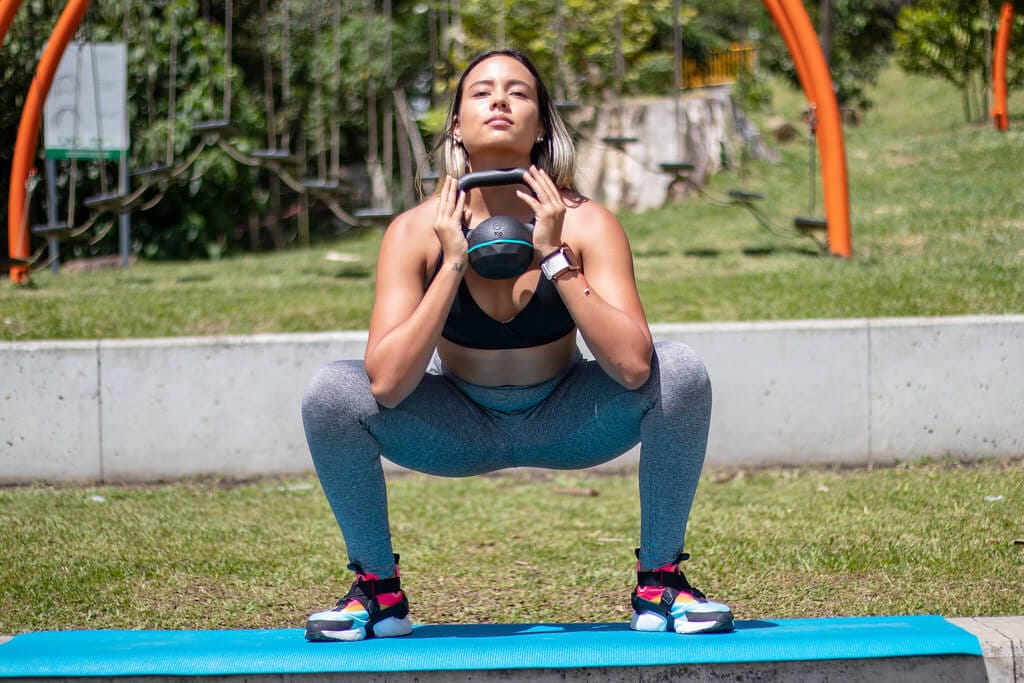
Sitting down on a chair and standing back up is a familiar example of a squat movement.
Squats primarily train the quadriceps, the muscles at the front of your thighs, and the glutes. Your trunk and other lower-body muscles also contribute.
The movement involves bending at both the hips and knees, then extending them to stand upright.
How to perform a bodyweight squat
- Stand with your feet approximately shoulder-width apart, with your toes pointing in a comfortable direction.
- Bend your hips and knees to lower your body.
- Keep your weight distributed across your feet without lifting your heels.
- Lower yourself as far as you can while maintaining balance and control.
- Push through your feet to return to standing.
Your knees may move past your toes as you squat. That’s a normal part of the movement for many people. Trying to prevent all forward knee movement can change how the hips and trunk move, without necessarily making the exercise safer.
Squat depth also varies. Your proportions, ankle mobility and the type of squat you’re performing can influence how low you can comfortably go.
Where to start: Try sitting down on a stable chair and standing up without using your hands. Once you can repeat the movement with control, hold a light dumbbell close to your chest for a goblet squat.
A leg press or supported squat can also be useful when balance is the main difficulty.
2. Hip Hinge: Moving From Your Hips
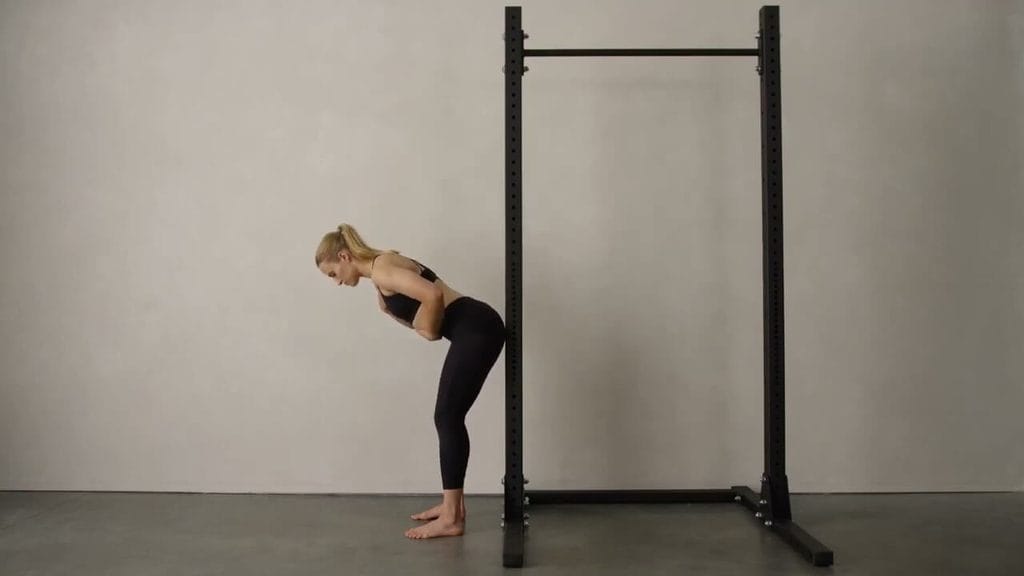
A hip hinge differs from a squat in how the movement is distributed between your hips and knees.
During a squat, both joints bend substantially. In a hip hinge, your hips move backward while your knees remain slightly bent, allowing your torso to lean forward.
This movement is used in exercises such as Romanian deadlifts and kettlebell deadlifts.
Loaded hip hinges train the glutes and hamstrings. Muscles along the spine also work to support the trunk.
How to practice a hip hinge
Stand with your feet about hip-width apart and bend your knees slightly.
Now push your hips backward, allowing your chest to move forward as your torso inclines. Keep your feet planted and your trunk controlled.
The movement should come mainly from your hips rather than repeatedly bending and straightening your knees.
Return to standing by extending your hips.
You can practice this without equipment. Once the movement feels familiar, hold a light dumbbell in each hand and try a Romanian deadlift.
With dumbbells, keep the weights close to your legs as you lower them. Stop when you’ve reached the range you can control, then stand back up.
There’s no requirement to reach the floor. The range should reflect your mobility, technique and the exercise you’re performing.
Watch for: Turning the exercise into a squat by bending your knees substantially while barely moving your hips backward.
A trainer can help you find a suitable range and position, particularly when you’re learning to hinge with weights.
3. Lunge: Training One Leg at a Time
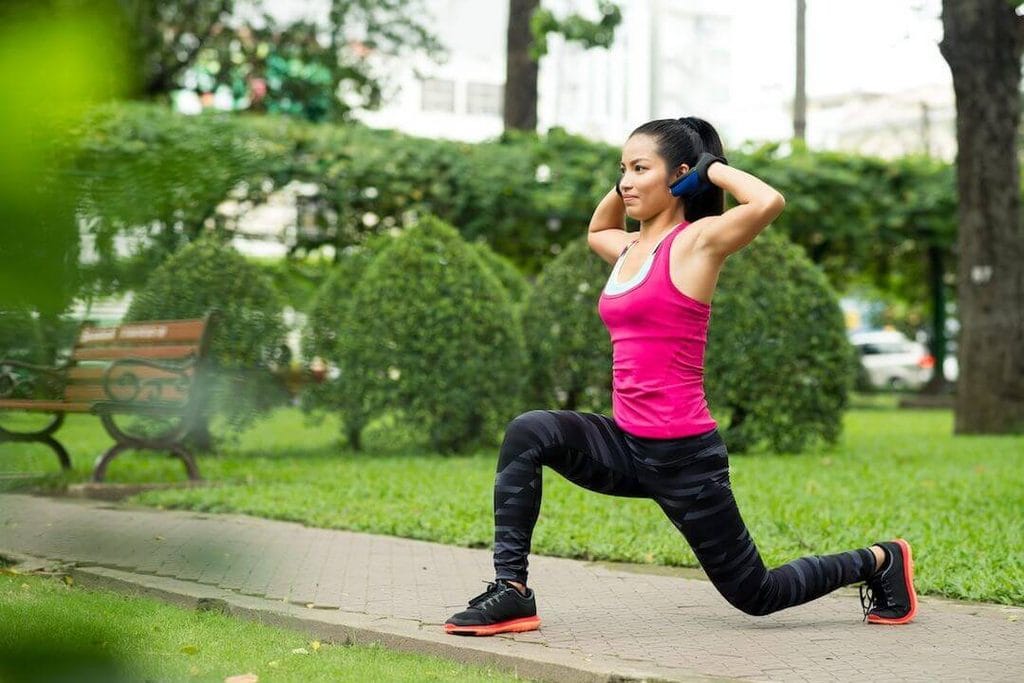
Squats involve both legs working together. Lunges place greater demands on one leg at a time.
They train the quadriceps and glutes while challenging balance and coordination.
Single-leg and staggered-stance exercises can also help you practice controlling each side independently. They don’t require both legs to have identical strength or movement ability before you begin.
For beginners, the reverse lunge is one option worth learning.
How to perform a reverse lunge
- Stand with your feet about hip-width apart.
- Step one foot backward, keeping some space between your feet from side to side.
- Bend both knees to lower your body.
- Keep your front foot planted and your torso controlled.
- Push through your front leg to return to standing.
- Complete your repetitions, then switch legs.
Your step length influences the movement. A very short step may feel cramped, while an excessively long step can make balance difficult.
Choose a distance that allows both knees to bend without pain.
Where to start: A stationary split squat is often easier to learn than repeatedly stepping backward. Hold a stable support for balance and lower yourself by bending both knees.
Low step-ups are another option for training one leg at a time.
When you’re ready to add resistance, begin with light dumbbells at your sides.
4. Push: Pressing Weight Away From Your Body
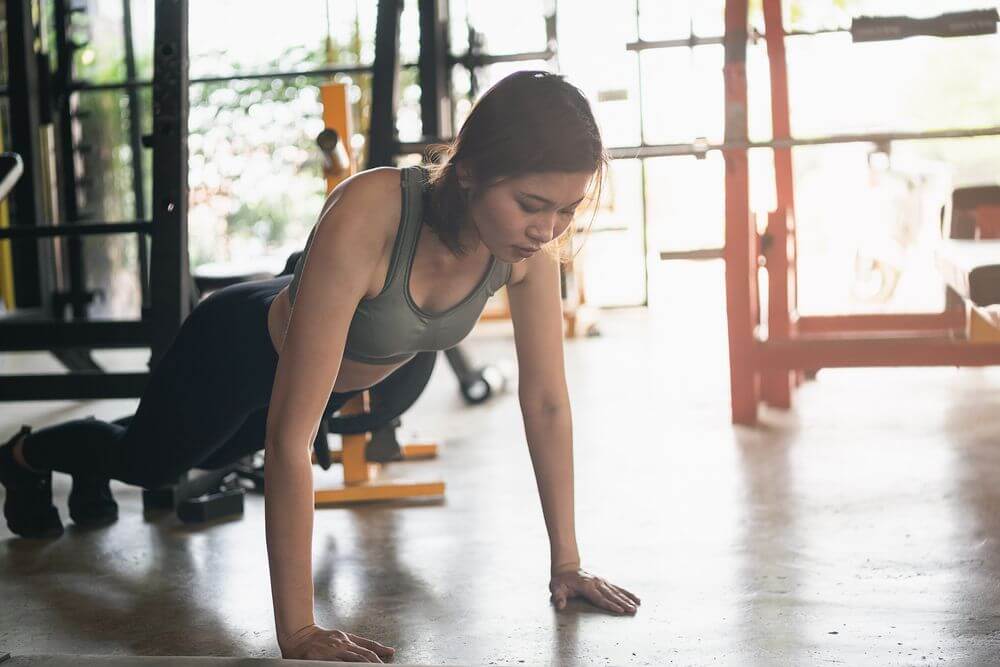
Pushing exercises train the chest, shoulders and triceps. Which muscles contribute most depends on the direction of the press.
A chest press moves weight forward, while a shoulder press moves it overhead.
You don’t need to begin with push-ups or an overhead barbell press. A machine chest press allows you to practice pressing with a guided movement path.
How to perform a machine chest press
- Adjust the seat so the handles are approximately level with your chest.
- Sit with your back supported and feet firmly on the floor.
- Grip the handles and position your elbows comfortably.
- Press forward without shrugging your shoulders.
- Return the handles slowly, stopping within a range that feels comfortable for your shoulders.
Avoid allowing the weight stack to drop abruptly between repetitions.
The handles, grip and range of motion differ between machines. Adjust the setup rather than forcing your shoulders into an uncomfortable position.
Where to start: Use a light resistance on the chest press machine. Wall push-ups and incline push-ups are useful options when you want to practice supporting and moving your own body weight.
Women can develop substantial upper-body strength through resistance training. A systematic review and meta-analysis of 24 studies involving adult women found improvements in muscular strength and muscle growth following training.
The review supports progressive resistance training for women, but it doesn’t establish one pressing exercise as superior to every other option.
5. Pull: Bringing Resistance Toward Your Body
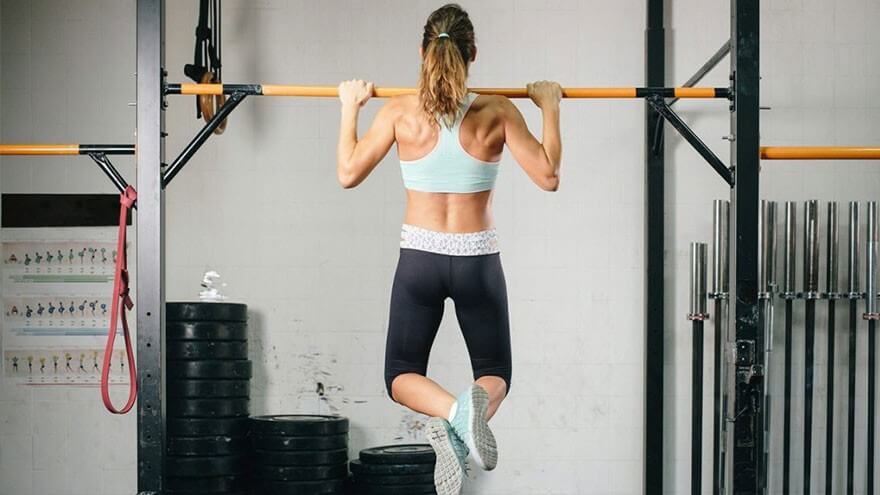
Pulling exercises work muscles in the back and arms.
There are two common directions:
- Horizontal pulling: Bringing resistance toward your torso, as in a seated cable row.
- Vertical pulling: Bringing resistance down from overhead, as in a lat pulldown.
These exercises share some muscle involvement, but they place different demands on the shoulders and upper back.
A seated row is a practical first pulling exercise.
How to perform a seated cable row
- Sit with your feet supported and knees slightly bent.
- Hold the handle and establish an upright, controlled torso position.
- Pull the handle toward your lower chest or upper abdomen, depending on the equipment.
- Allow your elbows to move backward without forcing your shoulders into an uncomfortable position.
- Extend your arms gradually to return the weight.
Your shoulder blades will move during the exercise. You don’t need to keep them fixed in one position throughout the repetition.
Avoid using a large backward swing to move a weight that’s too heavy.
Where to start: A chest-supported rowing machine reduces the balance and trunk-control demands of the exercise. Resistance bands are another practical option.
Once you’re familiar with rowing, a lat pulldown introduces vertical pulling.
You can train your back effectively with these exercises without being able to perform an unassisted pull-up.
6. Carry: Walking While Holding Weight
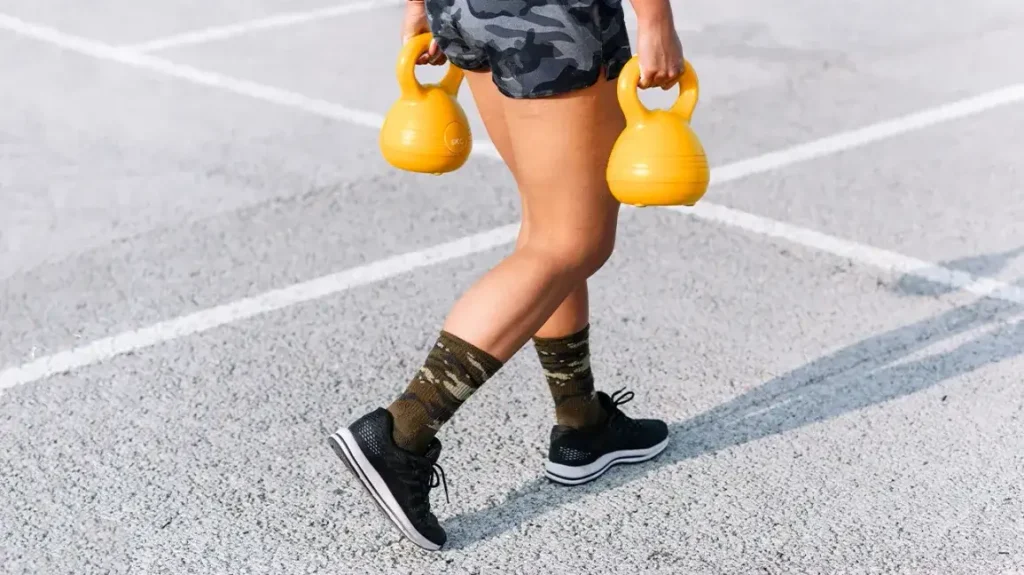
A farmer’s carry involves picking up weights, holding them at your sides and walking a short distance.
Carrying external weight challenges your grip, trunk stability and ability to maintain control while walking.
Your legs still perform the walking movement. The added resistance requires your upper body and trunk to support the load.
How to perform a farmer’s carry
Place two dumbbells beside your feet.
Pick them up using a controlled squat or hip hinge, then stand upright with your arms at your sides.
Walk at a steady pace along a clear path. Keep the weights from swinging excessively and maintain your normal breathing.
When you’ve finished, lower the dumbbells with control.
Start with weights you can hold securely throughout the walk. A distance of 10 to 20 meters can be a practical starting example, but there is no scientifically established distance that every beginner must use.
If your grip starts failing or you cannot maintain control, end the carry.
Another variation: Hold one dumbbell instead of two. This is called a suitcase carry.
With the weight on one side, your trunk must resist leaning toward it. Train both sides using a load you can carry without excessive leaning.
Carries are useful additions to a workout, but you can also develop grip and trunk strength through other exercises.
7. Brace: Controlling Your Trunk
Your abdominal muscles are part of a larger group of muscles that support and move your trunk.
During strength training, these muscles help you maintain control while your arms or legs move.
Bracing refers to creating tension through your trunk. The amount of tension needed changes with the exercise and the resistance you’re handling.
For example, a heavy squat demands a different level of trunk stiffness than a light chest press.
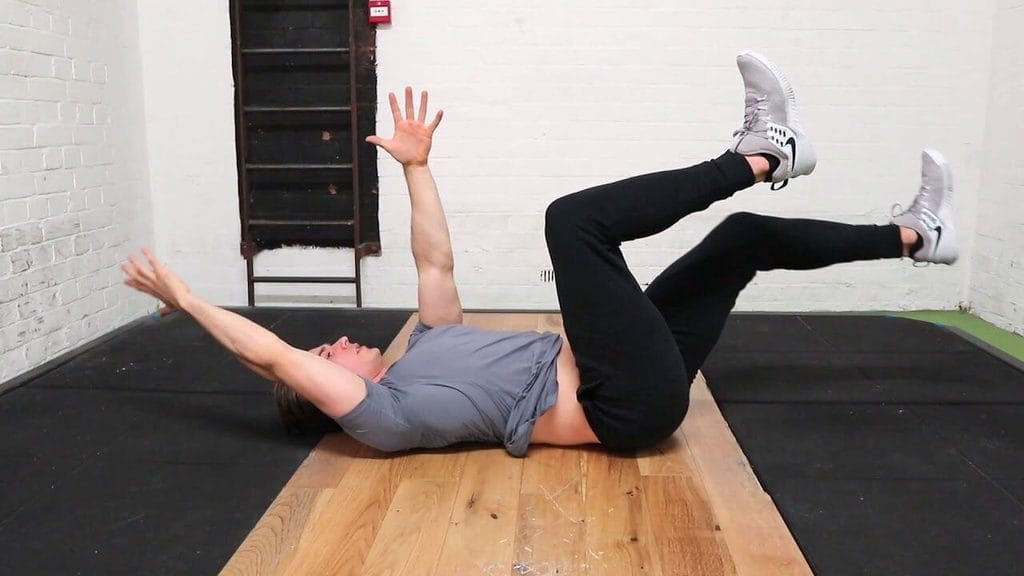
The dead bug is one way to practice controlling your trunk while moving your limbs.
How to perform a dead bug
- Lie on your back with your arms pointing toward the ceiling.
- Raise your legs so your hips and knees are bent at approximately 90 degrees.
- Gently tighten your abdominal muscles while continuing to breathe.
- Slowly extend one leg and lower the opposite arm toward the floor.
- Stop before your lower back begins moving farther than you can comfortably control.
- Return to the starting position and repeat on the opposite side.
If extending both your arm and leg feels difficult, begin by lowering one heel toward the floor while keeping your arms still.
You can gradually increase how far you extend your limbs.
A dead bug is primarily a trunk-control exercise. Its muscle-activation demands are not the same as those of heavily loaded abdominal exercises.
As your control improves, exercises such as planks, bird dogs and progressively loaded core movements can provide different challenges.
How These Movements Fit Into Strength Training
Learning a movement pattern doesn’t mean sticking to one exercise forever.
A squat can be practiced using a chair, a dumbbell or a machine. A pushing movement might involve a wall push-up, chest press machine or dumbbell press.
The exercises differ in their loading, balance requirements and movement paths, but they share enough characteristics to help you understand the underlying action.
Take the chest press as an example. If you’re comfortable using the machine and want to try dumbbells, you already understand the basic pressing direction. You’ll still need to learn how to control the independently moving weights.
The same principle applies when progressing from an unloaded hip hinge to a Romanian deadlift.
Should beginners use machines or free weights?
Both can help build muscle and strength.
A 2023 systematic review and meta-analysis found no statistically significant overall difference in muscle growth between machine-based and free-weight training.
The evidence was limited, particularly for muscle growth, and the finding does not mean both methods produce identical results in every situation.
Strength improvements were more closely related to the exercises participants practiced.
For beginners, equipment choice can depend on what they want to learn.
Machines often provide a guided path and reduce the need to control a freely moving weight. Dumbbells introduce greater freedom of movement and may demand more coordination.
Neither is a prerequisite for the other.
A Simple Strength-Training Workout for Beginners
You can begin with four movements that train several major muscle groups:
| Movement | Exercise | Sets | Repetitions |
|---|---|---|---|
| Squat | Chair squat or goblet squat | 2 | 8–12 |
| Hip hinge | Dumbbell Romanian deadlift | 2 | 8–12 |
| Push | Machine chest press | 2 | 8–12 |
| Pull | Seated cable row | 2 | 8–12 |
This is a sample workout for a healthy adult beginner, not a fixed prescription.
A set is a group of repetitions performed before resting. If you complete 10 squats, rest and repeat another 10, you’ve performed two sets of 10 repetitions.
Before the workout, spend a few minutes walking or cycling at an easy pace. Practice the first exercises with little or no added resistance to become familiar with their movement.
Choose weights that allow you to complete your repetitions with control while making the final few repetitions feel challenging.
Rest around one to two minutes between sets. Longer rests may be useful after demanding exercises or when you need more time to recover before the next set.
Once you’re comfortable with the four exercises, you can introduce other patterns without making every session unnecessarily long.
For example:
| Additional movement | Exercise | Starting example |
|---|---|---|
| Lunge | Supported split squat | 1–2 sets of 8 per leg |
| Carry | Farmer’s carry | 2 short walks |
| Brace | Dead bug | 2 sets of 6–10 per side |
These are options to introduce over time, not extra work you must complete immediately.
How often should you train?
For healthy adults, the World Health Organization recommends muscle-strengthening activity involving all major muscle groups at moderate or greater intensity on at least two days per week.
Two full-body sessions separated by a rest day can be a reasonable starting schedule.
The American College of Sports Medicine’s 2026 resistance training position stand supports resistance training for improving strength and muscle size, while allowing flexibility in exercise selection and program design.
Women don’t need a fundamentally different set of training principles simply on account of their sex. Exercise selection and training demands should reflect individual ability, goals and recovery.
When Should You Increase the Weight?
Consider a beginner performing goblet squats with a 4-kilogram dumbbell.
She completes two sets of eight repetitions during her first workout.
After practicing the exercise over several sessions, she can complete two sets of 12 repetitions with control and feels capable of performing a few more.
At that point, she can try a slightly heavier dumbbell.
She might return to eight repetitions with the new weight and gradually increase them again.
This is an example of progressive overload, the process of increasing training demands as your strength and ability improve.
You don’t have to increase the weight in every workout.
If the next available dumbbell is too heavy, continue practicing with your current weight. More controlled repetitions, an appropriate increase in sets or a suitable exercise variation may offer another way to progress.
A 2023 systematic review and network meta-analysis of resistance-training prescriptions found that a range of training approaches can improve strength and muscle growth. Heavier loads tend to favor maximal strength, while multiple-set programs can support muscle growth.
There is no single repetition range that works for every training goal.
How Do You Know if You’re Performing an Exercise Correctly?
Exercise technique isn’t identical for everyone.
A woman with longer thighs may squat with a different torso angle than someone with shorter legs. Shoulder mobility and machine design can influence how a chest press feels.
Instead of trying to copy another person’s movement exactly, pay attention to what happens during your own repetitions.
Three useful checks are:
- Control: Can you move the weight without losing balance, dropping it or relying on an unintended swing?
- Repeatability: Do the later repetitions look reasonably similar to the earlier ones?
- Comfort: Can you perform the movement through a useful range without pain or concerning symptoms?
If control deteriorates as a set continues, stopping the set or reducing the weight may be appropriate.
Muscular effort and fatigue are expected during resistance training. Sharp pain, new numbness, dizziness or other unusual symptoms warrant stopping the exercise. Seek medical assessment when symptoms are severe, persistent or concerning.
Women who are pregnant, recovering from childbirth or managing a medical condition or injury may need individual guidance before performing certain exercises.
A qualified trainer can also help determine whether a movement needs a change in setup, resistance or range of motion.
Start With the Movement, Then Choose the Exercise
The seven patterns provide a way to understand what you’re training.
You might begin with chair squats and later move to goblet squats. A seated row may become a dumbbell row. An unloaded hip hinge can progress to a Romanian deadlift.
Each new exercise brings its own technique and loading demands, so familiarity with a movement pattern doesn’t automatically mean you’ve mastered every variation.
For a broader introduction to gym training, read our beginner’s guide to strength training for women.
When choosing exercises, focus on which muscles and movements you want to train, the equipment available and the resistance you can handle with control. Those factors are more useful than trying to fit every possible exercise into one workout.
SOURCES
- American College of Sports Medicine (2026). Resistance Training Prescription for Muscle Function, Hypertrophy, and Physical Performance in Healthy Adults: An Overview of Reviews. Evidence on resistance-training frequency, exercise selection, loading and progression.
- World Health Organization (2020). WHO Guidelines on Physical Activity and Sedentary Behaviour. Public-health recommendations for muscle-strengthening activity.
- Systematic review and meta-analysis (2020). The Effect of Resistance Training in Women on Dynamic Strength and Muscular Hypertrophy. Findings on strength and muscle growth in healthy adult women.
- Systematic review and meta-analysis (2023). Effect of Free-Weight vs. Machine-Based Strength Training on Maximal Strength, Hypertrophy and Jump Performance. Comparison of machine and free-weight training outcomes.
- Systematic review and network meta-analysis (2023). Resistance Training Prescription for Muscle Strength and Hypertrophy in Healthy Adults. Evidence comparing training loads, sets and frequencies.
Start with guidance, not guesswork.
Visit BARBELLE by J.Lara, meet our female coaches, and experience a ladies-only training space built around learning and progress.
Book your free trial