
No. Lifting weights does not automatically make women bulky.
It can build muscle. Pretending otherwise is not useful. Women respond well to resistance training, and muscle growth is one possible response.
What lifting does not do is push every woman toward the same physique. The amount of muscle you gain depends partly on the training stimulus each muscle receives over time. Strength can also rise without muscle size increasing at the same rate.
If your concern is, “Will I suddenly become much bigger if I start lifting heavier weights?” the evidence gives a more useful answer than a simple no.
Bulky is not something researchers measure
There is no scientific definition of a bulky physique.
Studies can measure changes in muscle thickness, muscle cross-sectional area, muscle fiber size and body composition. Researchers can also test how much stronger someone becomes. Hypertrophy is the term used for an increase in muscle size.
They cannot determine when a person looks too muscular. That is a personal judgment.
One woman might want visibly larger shoulders or stronger-looking legs. Another may want to become much stronger with less interest in increasing muscle size. Both are legitimate training goals.
The useful question is not whether weights make women bulky. It is how resistance training changes muscle and how much the training program can influence that change.
What happens when you start lifting weights?
Getting stronger and building bigger muscles are related, but they are not the same response.
Strength can improve through changes in the nervous system. A systematic review and meta-analysis of 30 randomized controlled trials found neural changes after resistance training that likely contribute to increases in strength.
That helps explain why a beginner can become noticeably better at lifting before seeing a comparable change in muscle size.
If you are new to lifting, BARBELLE’s Strength Training for Women: A Beginner’s Guide explains how to start, choose your weights and progress your training.
Muscle growth can occur too. A systematic review focused on resistance training in women examined 24 studies and found substantial improvements in upper- and lower-body strength, along with a moderate hypertrophy effect.
There is another wrinkle during the first weeks of training. A muscle may temporarily look or measure larger without all of that increase representing new muscle tissue.
A study of 10 untrained young men found that some early increases in muscle cross-sectional area occurred alongside exercise-related swelling. The study was conducted in men, so it should not be treated as women-specific evidence. It does show why an early increase in measured muscle size is not always the same thing as newly built muscle tissue.
Women can build a meaningful amount of muscle
The idea that women barely build muscle from lifting does not match the training research.
One of the strongest recent analyses compared men and women completing the same resistance-training programs. The 2025 systematic review of sex differences in resistance-training responses included 29 studies of healthy adults ages 18 to 45.
Men had slightly greater absolute increases in muscle size. Relative increases from each person’s starting point were similar between the sexes.
Imagine two people begin with different amounts of muscle. A similar percentage increase does not have to produce the same amount of new muscle in kilograms or the same visual result.
An earlier 2020 meta-analysis also found no statistically significant sex difference in hypertrophy across the studies it assessed, though the hypertrophy analysis was smaller, with 12 outcomes from 10 studies.
The evidence does not say every woman will gain muscle at the same rate as every man. It shows that women have a real capacity for hypertrophy and can respond strongly to resistance training.
Does lifting heavier weights make you bigger?
Not by itself.
Heavier weights have a clear role in developing maximal strength. Muscle growth is less tightly tied to how heavy the weight is.
A 2026 position stand from the American College of Sports Medicine reviewed 137 systematic reviews involving more than 30,000 participants. Resistance training increased both muscle strength and muscle size. Heavier loads, around 80% of one-repetition maximum or above, produced greater gains in voluntary strength.
One-repetition maximum, often shortened to 1RM, means the heaviest load you can lift once for a given exercise.
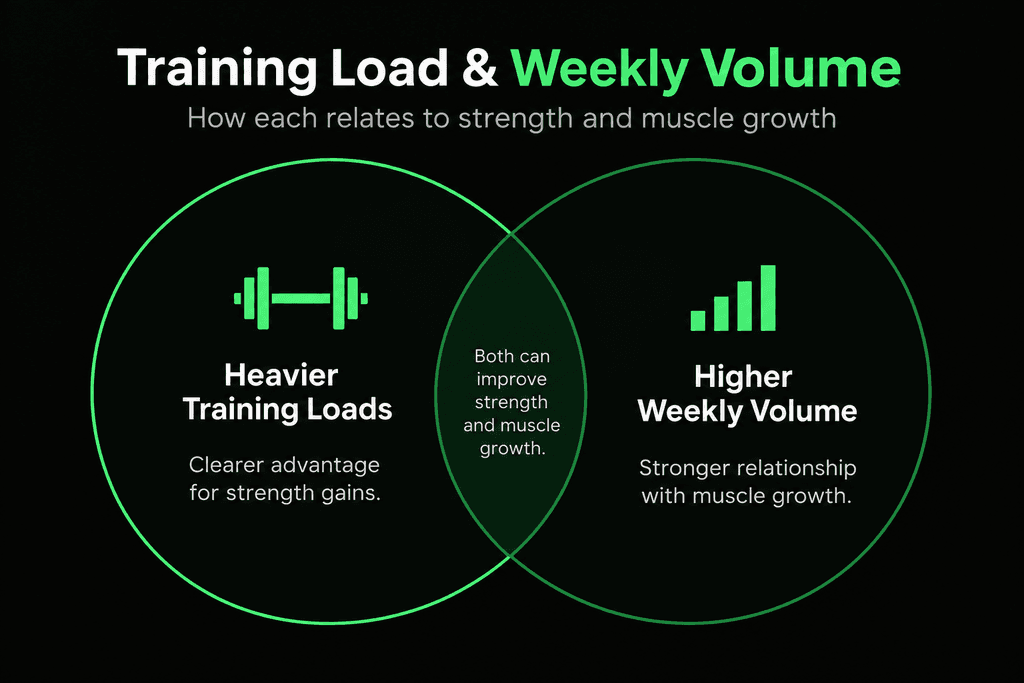
For hypertrophy, higher training volume had a clearer effect than heavier loading. The ACSM review found greater muscle growth with higher weekly volumes, while many other programming variables had little consistent effect on hypertrophy.
A separate systematic review and meta-analysis found similar hypertrophy with higher- and lower-load training, while heavier training produced greater gains in 1RM and isometric strength.
If you have been avoiding heavier dumbbells out of fear that crossing some imaginary weight threshold will suddenly make your muscles much larger, the research does not support that idea.
There is no such threshold.
Light weights are not a way to avoid muscle growth
High-repetition training with lighter resistance can also stimulate hypertrophy.
A 2021 systematic review and network meta-analysis compared low-, moderate- and high-load resistance training taken to volitional failure. It found no significant difference in hypertrophy across the loading ranges, while heavier loading produced greater strength gains.
Light weights therefore do not offer a special way to avoid muscle growth. Heavy weights are not a direct route to large muscles either.
Load matters a great deal when maximal strength is the goal. Muscle growth can occur across a broad range of loads.
Training volume matters when muscle size is the goal
Training volume is one useful lever when you want more or less emphasis on hypertrophy.
In resistance training, volume can refer to how much work a muscle receives across exercises and sets. The 2026 ACSM position stand found greater hypertrophy with higher weekly volumes, with evidence favoring about 10 or more sets per muscle group each week.
That number is not a magic cutoff or a required minimum. Muscle can grow with less work, and adding sets does not produce unlimited growth.
Doing a few challenging sets with a heavy weight is not the same training stimulus as repeatedly giving a muscle a high amount of direct weekly work with the goal of maximizing its growth.
Does eating more make you gain more muscle?
Training supplies the muscle-building stimulus. Nutrition can affect the response.
Protein intake is part of that picture. A large meta-analysis on protein supplementation and resistance training found that adding protein to a resistance-training program produced small additional gains in muscle mass and strength. The benefit became smaller as total protein intake rose, which is one reason a protein supplement is not automatically useful for someone who already eats enough protein.
Energy intake matters too, but research has not established a single calorie surplus required to maximize muscle growth. A review of energy surplus and muscle hypertrophy found that the size of an ideal surplus remains unknown.
What is clearer is that a prolonged energy deficit can make lean-mass gains harder. A meta-analysis examining resistance training during an energy deficit found smaller gains in lean mass, while strength gains were not significantly different.
Eating more energy also does not mean every extra kilogram gained will be muscle. Food intake can support muscle growth, but it does not create a predictable point at which lifting starts making someone bulky.
Can you get stronger without trying to maximize muscle size?
Yes.
Strength and hypertrophy overlap, so no program can promise strength gains with zero muscle growth. A program can still place more emphasis on one response than the other.
The ACSM evidence makes that distinction useful. Heavier loading has a stronger relationship with maximal-strength development. Higher weekly volume has a stronger relationship with maximizing hypertrophy.
If you want to become stronger but do not want to chase maximum muscle size, you do not need to keep adding more direct work for every muscle.
If one area starts developing more than you prefer, the amount of direct training it receives can be reassessed. Research supports a volume-response relationship for hypertrophy, but no set number of exercises or sets can predict exactly how one person’s physique will respond.
That is very different from refusing to lift heavier weights.
What does resistance training usually change in women?
Strength is one of the clearest changes seen in the research.
A 2026 systematic review and meta-analysis of resistance training in women across adulthood examined 126 studies involving 4,019 women. Resistance training improved muscular strength in both premenopausal and postmenopausal women. The review also reported increases in functional mass and reductions in fat mass at the group level. About two-thirds of the participants were postmenopausal, so those body-composition findings should not be treated as a prediction for every woman who starts lifting.
The size and mix of these changes will vary from one person to another. A heavier dumbbell alone does not tell you what the final result will look like.
You do not need a special women’s version of strength training
Women respond to resistance training. The evidence does not support restricting women to very light weights or high-repetition workouts just to avoid becoming too muscular.
The 2026 review covering women across adulthood concluded that broad resistance-training guidelines appear applicable to women, with individual programming taking priority over rigid sex- or age-based rules.
Goals still matter. A woman training to maximize muscle growth may use a different amount of weekly work from someone focused mainly on getting stronger. Someone new to lifting will need different programming from an experienced lifter. Exercise selection can change with ability, preference and available equipment.
Those are programming decisions, not rules about what women should or should not lift.
So, will lifting weights make you bulky?
Lifting can increase muscle size. Heavier weights alone do not determine how much muscle you gain.
If strength is the main goal, heavier loading can be useful. If you want to place more or less emphasis on muscle growth, weekly training volume is one of the main variables to adjust.
A heavier dumbbell does not switch hypertrophy on. A lighter one does not switch it off.
SOURCES
- Siddique et al., systematic review and meta-analysis of neural changes associated with resistance training, 2020
- Hagstrom et al., The Effect of Resistance Training in Women on Dynamic Strength and Muscular Hypertrophy, 2020
- Damas et al., research on early resistance-training muscle swelling and hypertrophy, 2016
- Refalo et al., systematic review and Bayesian meta-analysis of sex differences in resistance-training adaptations, 2025
- Roberts, Nuckols and Krieger, Sex Differences in Resistance Training: A Systematic Review and Meta-Analysis, 2020
- American College of Sports Medicine, resistance-training position stand, 2026
- Systematic review and meta-analysis comparing higher- and lower-load resistance training, 2021
- Lopez et al., systematic review and network meta-analysis comparing resistance-training loads for strength and hypertrophy, 2021
- Morton et al., systematic review and meta-analysis of protein supplementation during resistance training, 2018
- Slater et al., review of energy surplus and skeletal muscle hypertrophy, 2019
- Murphy and Koehler, meta-analysis of energy deficiency and resistance-training outcomes, 2022
- Systematic review and meta-analysis of resistance training in women across adulthood, 2026
Start with guidance, not guesswork.
Visit BARBELLE by J.Lara, meet our female coaches, and experience a ladies-only training space built around learning and progress.
Book your free trial